
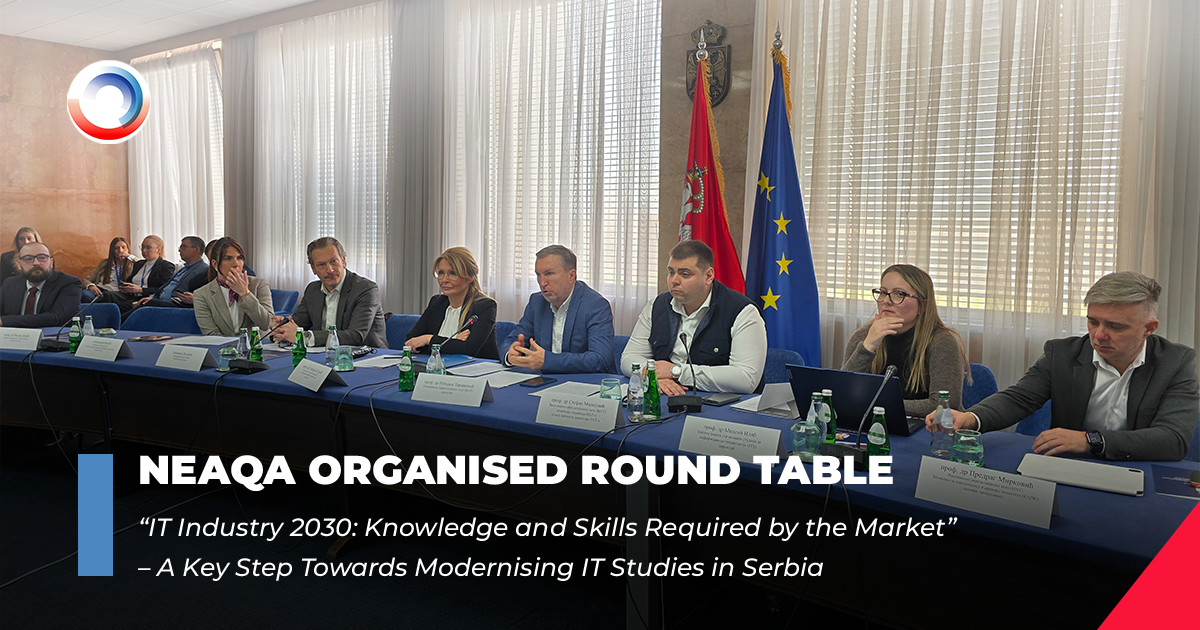
Organised by the National Entity for Accreditation and Quality Assurance in Higher Education (NEAQA), a round table entitled “IT Industry 2030: Knowledge and Skills Required by the Market” was held on 19 February 2026 at the Palace of Serbia in Belgrade. The event was dedicated to improving and aligning study programmes in the field of information technology with the needs of the modern labour market.
The aim of the event was, through a structured dialogue between representatives of the IT industry, the academic community and NEAQA, to identify the key knowledge, skills and competencies required for work in the contemporary IT sector, as a basis for reforming and innovating existing study programmes and developing new ones
Dialogue Shaping the Future
The event brought together representatives of higher education institutions, IT companies and the business sector, state institutions and relevant public bodies, as well as representatives of professional and business associations.
Such a structure of participants ensured a comprehensive insight into the real needs of the IT industry and enabled a direct connection between the higher education system and the dynamic demands of the digital economy
The particular importance of the round table lies in the fact that its conclusions and recommendations were announced as the basis for preparing proposals for amendments to the accreditation standards for study programmes
This represents a concrete institutional mechanism through which the results of the discussion will have a long-term impact on the higher education system in Serbia
Key Topics: From Technical Knowledge to Soft Skills
The discussion focused on the following issues:
- Which technical knowledge and practical skills are lacking among young IT professionals;
- How to improve and institutionalise models of professional practice during studies;
- What are the advantages of short study programmes and micro-credentials;
- How to directly involve industry in the creation and evaluation of study programmes;
- How to involve industry in dual study programmes
In addition to technical competencies, special attention was also given to the development of soft skills – communication skills, teamwork, project management and adaptability – which were recognised as essential for working in modern IT teams
Importance for the Higher Education System and the Economy
The rapid development of artificial intelligence, cyber security, data science, cloud and fintech solutions, as well as the digitalisation of the public and private sectors, requires continuous alignment of educational programmes with the real needs of the labour market
This round table represents an important step towards:
- Systemic integration of higher education and the IT industry;
- Strengthening the role of employers in the quality assurance process;
- Modernising accreditation standards in line with European recommendations and ESG standards;
- The strategic development of the digital economy of the Republic of Serbia
By organising this event, NEAQA clearly reaffirmed its role not only as a regulatory body, but also as an active initiator of dialogue and reform processes in higher education.
Institutional Responsibility and Vision 2030
The conclusions of the round table will be formulated into concrete recommendations for higher education institutions and for the improvement of accreditation standards for IT study programmes
This represents an important step towards building a system that will ensure education does not lag behind industry development, but instead acts as its partner and driver of innovation
By holding this event, the foundations have been laid for long-term cooperation between the academic community and industry, with a clear vision – that by 2030 Serbia will have a higher education system that actively shapes competitive, innovative and globally relevant IT professionals.