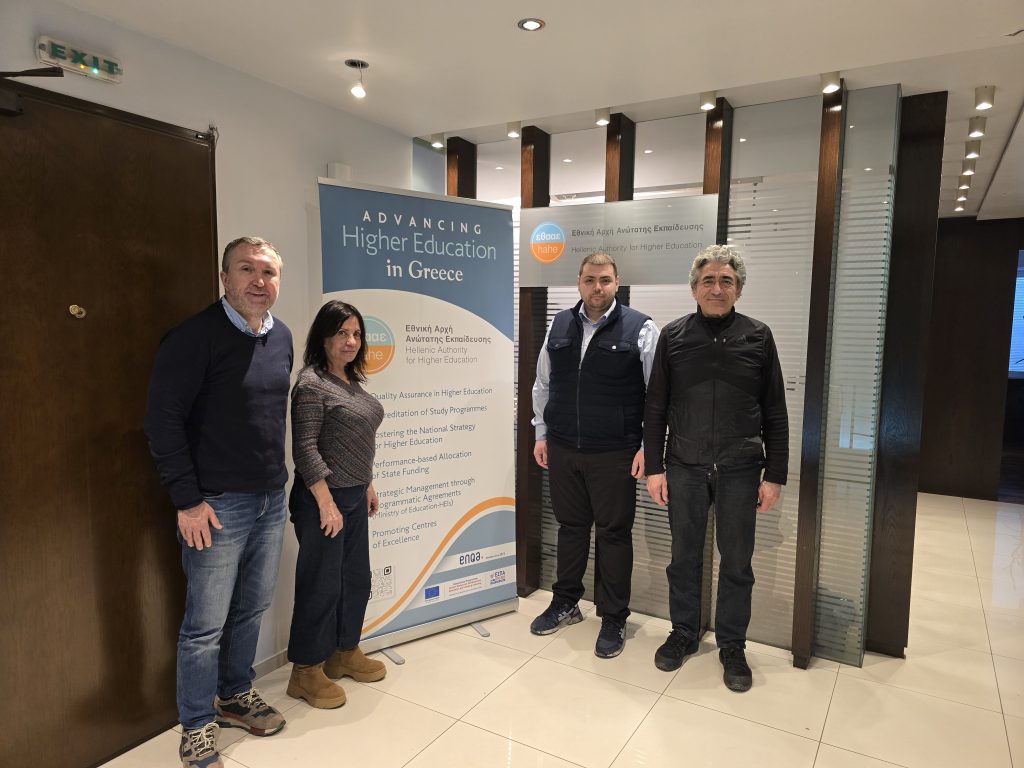
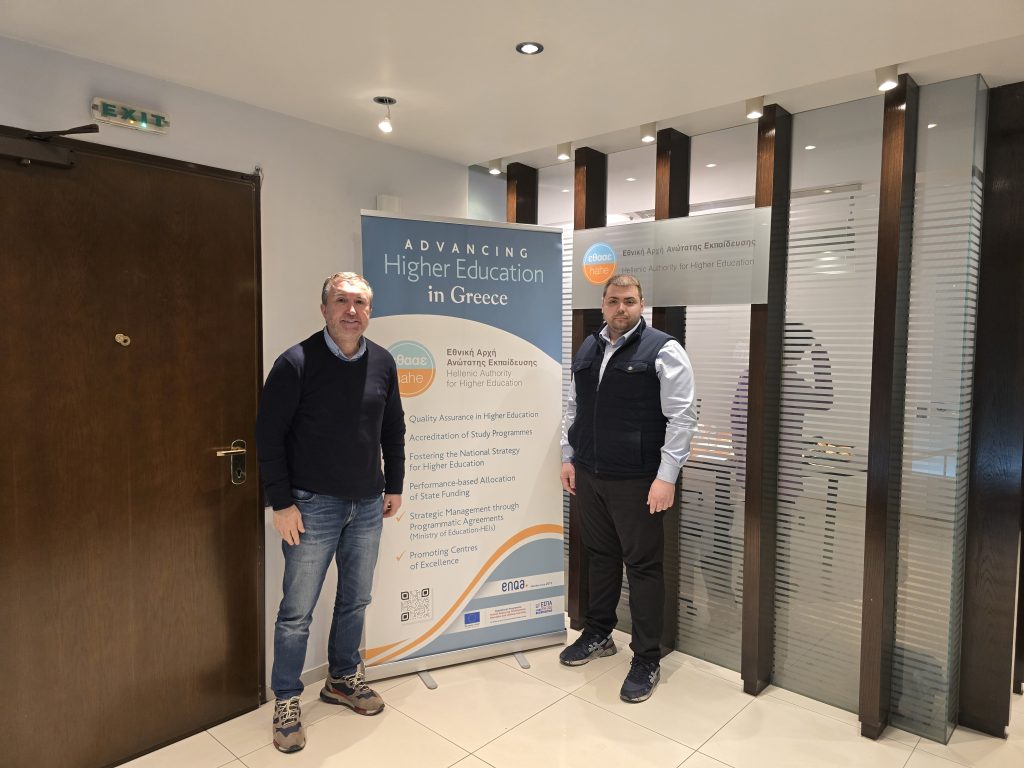
In order to strengthen international cooperation and exchange best practices in the field of quality assurance in higher education, a delegation from the National Entity for Accreditation and Quality Assurance in Higher Education (NEAQA), consisting of Prof. Dr. Nebojša Zdravković, Director of NEAQA, and Prof. Dr. Stefan Milojević, Chief of Staff and Assistant Director of NEAQA, visited the Hellenic Authority for Higher Education (HAHE) in Athens, Greece, from February 17 to 18, 2025.
This visit represents an important step in continuing the highly successful collaboration initiated through an online meeting held on January 16, 2025, which has now been further deepened through direct discussions and exchange of experiences with leading experts in the field of accreditation and quality assurance.
Exchange of Experiences and Presentation of Best Practices
During the two-day visit, representatives of HAHE, led by Dr. Christina Best, General Director, provided a detailed presentation of the Greek accreditation system, with a special focus on the selection and training of reviewers, procedures for handling complaints and appeals, as well as the presentation of software that significantly contributes to the efficiency and transparency of accreditation procedures.
These topics were the subject of intensive discussions and analyses, with consideration given to the possibility of adapting and applying best practices within the Serbian accreditation system. Special attention was devoted to the methods of collecting and utilizing feedback from higher education institutions and other relevant stakeholders, which is a key factor in the continuous improvement of the accreditation process.
New Steps in Enhancing the Accreditation System
Based on this visit and collaboration with the Greek agency, NEAQA will implement a series of innovations recognized as examples of good practice in the upcoming period:
Improvement of the Complaint Procedure
- A standardized form for submitting complaints regarding the work of reviewers will be developed, including the establishment of an appropriate procedure.
- It will also be possible to submit complaints concerning the ethical conduct of reviewers in the accreditation process.
Enhancing the Quality of Reviewers and Their Work
- The public call for the application of reviewers will remain permanently open, for both domestic and international experts.
- The reviewer list will be updated annually, ensuring it aligns with current data on all reviewers.
- Reviewers will be categorized according to UNESCO classifications, ensuring a higher level of expertise and representativeness.
- An initial briefing session for the review committee will be introduced immediately upon appointment, where a coordinator from NEAQA’s professional service will outline roles, deadlines, and methodologies before reviewers receive accreditation documentation.
- A clearer protocol for site visits to higher education institutions will be established, specifically defining which stakeholders (students, alumni, industry representatives, etc.) must be included.
- Students will be allowed to participate as reviewers only for study programs within their own scientific or artistic field.
- The inclusion of students in accreditation and quality assurance processes will be further regulated, in line with the best practices of the Greek agency (undergraduate students will only be able to review undergraduate programs, master’s students will only review master’s programs, and doctoral students will be able to review doctoral and master’s programs, but not undergraduate programs).
Better Communication with Higher Education Institutions
- Specialized quality training sessions for representatives of higher education institutions will be organized to improve the accreditation and quality assurance process.
- Institutions will have three days to declare potential conflicts of interest regarding reviewers appointed in the accreditation process.
- Institutions will complete a satisfaction survey at the end of the accreditation process.
Tracking the Impact of Accreditation on Graduate Careers
- A study will be conducted to analyze the position of graduates in the labor market – graduates will provide feedback 12 months after graduation and again five years later, regarding their career paths and employment status.
Transparency
- A “Knowledge Repository” will be created on NEAQA’s website – a database of essential information on accreditation and quality assurance in higher education (terminology, principles, procedures, and more) to inform the public about NEAQA’s work.
- Final reports of review committees, as well as decisions from the Commission for Accreditation (CAQA), Appeals Commission, and NEAQA certifications, will be publicly available on the NEAQA website.
Implementation of Modern Technological Tools
- NEAQA will work on implementing a Business Intelligence (BI) system to monitor and improve accreditation processes, enabling better data analysis and evidence-based strategic decision-making.
- A comparison of student enrollment by fields in Serbia and the European Union will be established, using EUROSTAT data to analyze higher education trends.
Formalizing Cooperation and Next Steps
The visit to the Greek agency resulted in firm agreements on future cooperation and expert exchanges, as well as plans to formalize the partnership through the signing of a Memorandum of Understanding. This step will enable long-term institutional collaboration, opening new opportunities for knowledge exchange, joint research projects, and the improvement of higher education systems in both countries.
Representatives of both agencies expressed great satisfaction with the outcomes of all meetings, emphasizing that this visit is yet another proof of the importance of international cooperation in improving quality standards in higher education.
NEAQA remains committed to the continuous improvement of accreditation processes, following the most advanced international standards and best European practices. This visit marks a significant step toward enhancing the quality of higher education in Serbia, laying solid foundations for future cooperation and innovations in the accreditation system.