
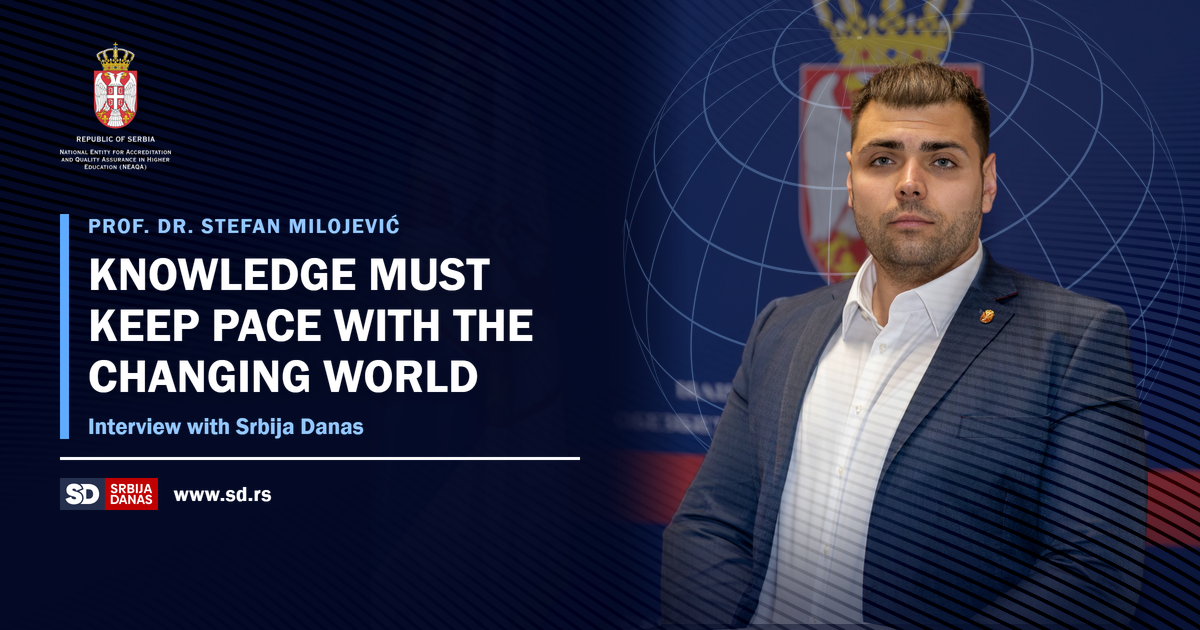
Prof. Dr. Stefan Milojević, university professor, Assistant Director for Accreditation and External Quality Assurance and Head of the Director’s Office at the National Entity for Accreditation and Quality Assurance in Higher Education (NAT), gave an interview to the Srbija Danas news portal, discussing the future of higher education, the importance of continuous professional development, and new opportunities for career advancement through short study programmes and micro-credentials.
In the interview published on October 12, 2026, Prof. Dr. Stefan Milojević highlighted the significant changes that modern technologies, digitalisation, and artificial intelligence are bringing to the education system and the labour market. He emphasised that obtaining a university degree represents an important foundation, but not the end of the educational process.
According to Milojević, the rapid pace of technological and societal change requires a new approach to professional development, in which the continuous acquisition of knowledge and improvement of competencies become essential throughout an individual’s working life.
Milojević pointed out that further education should not be viewed solely as an individual ambition of employees, but also as an important element in the development of institutions, companies, and society as a whole. Investing in knowledge contributes to higher-quality work, greater professional security, and the ability of organisations to respond effectively to contemporary challenges.
Short Study Programmes and Micro-Credentials as New Opportunities for Professional Development
Prof. Dr. Stefan Milojević devoted a significant part of the interview to short study programmes and micro-credentials, which represent flexible forms of education designed to help individuals acquire new professional competencies and enhance existing ones.
As he explained, these programmes enable employees to gain specific, practically applicable knowledge without having to complete an entire cycle of formal education again.
Short study programmes focus on acquiring a broader set of knowledge and skills required to perform particular professional tasks, while micro-credentials provide opportunities for targeted professional development in more specialised fields.
Milojević cited examples of their application in the financial sector, project management, data analysis, financial fraud prevention, and the digitalisation of administrative procedures.
In this way, he explained, higher education gains additional opportunities to respond to the specific needs of employees and employers while maintaining academic standards.
Quality of Education Must Remain a Fundamental Principle
Discussing the importance of the institutional framework, Prof. Dr. Stefan Milojević particularly emphasised the need to ensure the quality of short study programmes and micro-credentials.
During the interview, he recalled that a new regulation was adopted in January 2026, further defining the requirements, implementation procedures, and verification processes for these educational programmes.
According to Milojević, the National Entity for Accreditation and Quality Assurance in Higher Education plays an important role in verification procedures, which assess programme content, teaching staff competencies, learning outcomes, and implementation conditions.
Milojević stressed that more flexible forms of education must not imply lower quality standards. On the contrary, clearly defined criteria and reliable evaluation procedures form the foundation of trust in acquired knowledge and issued certificates.
Investing in Employees’ Knowledge Means Investing in an Organisation’s Future
A substantial part of the discussion focused on the role of companies, institutions, and the public sector in encouraging continuous professional development.
Prof. Dr. Stefan Milojević pointed out that the quality of human resources is one of the key factors determining the success of any organisation.
In his view, employers should consider not only the competencies their employees currently possess, but also the knowledge and skills they will need in the future.
Short study programmes and micro-credentials can contribute to the systematic development of employees, the improvement of business processes, and more effective adaptation to changes in the business environment.
He particularly emphasised the importance of making continuing education accessible to all categories of employees, regardless of whether they perform managerial, professional, administrative, or operational duties.
Serbia Should Keep Pace with European Educational Trends
In his interview with Srbija Danas, Milojević also addressed European trends in lifelong learning, particularly the development of micro-credentials as an additional means of acquiring and formally recognising professional competencies.
He recalled that in 2022, the Council of the European Union adopted a recommendation on a European approach to micro-credentials, further recognising their importance for professional development and employability.
In his opinion, it is important for Serbia to follow relevant European principles while taking into account the quality and specific characteristics of its national higher education system.
Milojević also highlighted the need to strengthen cooperation between higher education institutions, the business community, and the public sector in order to develop educational content that has clear practical applications while preserving long-term academic and societal value.
A Degree Is the Foundation, but Learning Continues Throughout One’s Career
Concluding the interview, Prof. Dr. Stefan Milojević emphasised that professional development does not necessarily involve changing jobs or advancing to a managerial position. It can also mean improving the quality of one’s work, gaining greater independence, and developing a better understanding of modern technologies.
His central message is that formal education provides the foundation for professional development, but that a willingness to engage in continuous learning and adapt to new circumstances determines an individual’s ability to meet future challenges.
The interview with Prof. Dr. Stefan Milojević raises important questions about the further development of higher education in Serbia, the role of educational institutions in modern society, and the importance of building a system that enables the continuous acquisition of knowledge throughout an individual’s professional life.
The full interview with Prof. Dr. Stefan Milojević, published by Srbija Danas on October 12, 2026, under the title “A Degree Is the Foundation, but Knowledge Must Be Continuously Expanded Throughout One’s Career,” is available at the following link: