
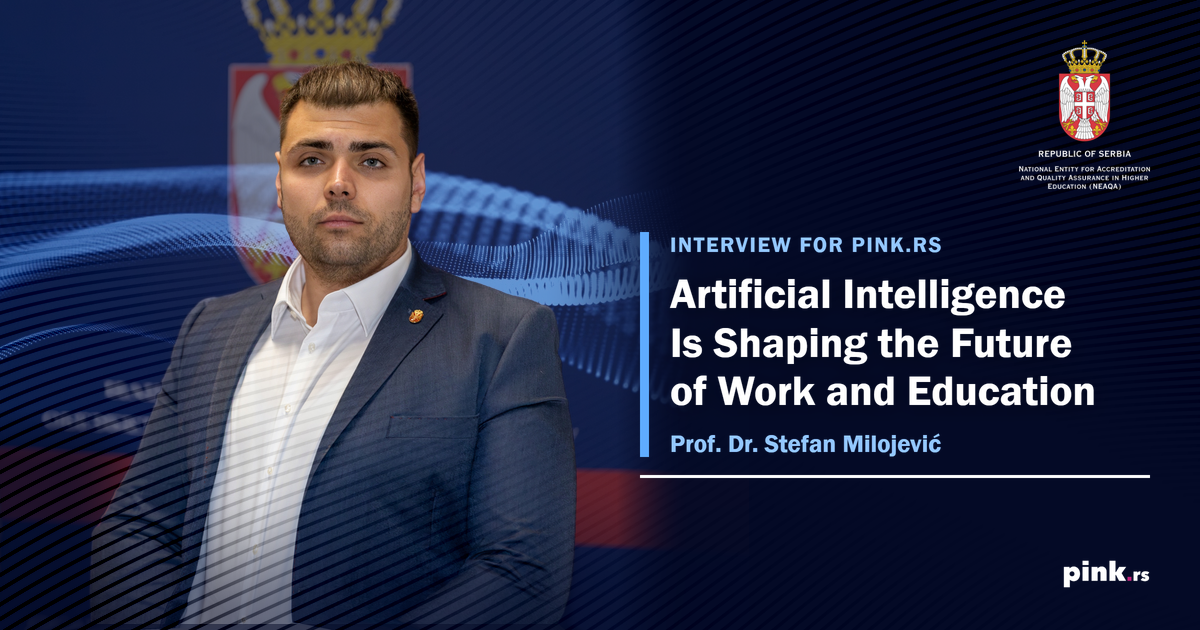
Prof. Dr. Stefan Milojević, Assistant Director for Accreditation and External Quality Assurance and Head of the Director’s Office at the National Entity for Accreditation and Quality Assurance in Higher Education (NAT), spoke in an interview with the Pink.rs news portal about the impact of artificial intelligence on the labor market, the future of professions, the development of competencies, and the role of higher education institutions in modern society.
In an extensive interview, Prof. Dr. Stefan Milojević emphasized that artificial intelligence is no longer a technology of the future but has become an integral part of today’s business and educational environment, transforming the ways in which people work, learn, and make decisions.
According to Milojević, the development of artificial intelligence should not be viewed solely through the possibility of certain professions disappearing, but primarily through the transformation of existing jobs and the growing need to acquire new knowledge and skills.
“In many cases, entire professions will not disappear; rather, certain tasks that form an integral part of those professions will,” Milojević pointed out.
Universities Play a Key Role in Preparing for the Future
During the interview, Prof. Dr. Milojević devoted particular attention to the role of higher education in an era of rapid technological development.
He emphasized that universities must preserve their fundamental mission – the advancement of knowledge, science, critical thinking, and professional expertise – while simultaneously adapting educational processes to the evolving needs of society and the economy.
As he explained, high-quality higher education involves not only familiarity with modern digital tools but also the ability to apply them responsibly and critically in real-world professional situations.
“The most important thing is that universities should not educate individuals merely for their first job, but equip them with the ability to continue learning, adapting, and assuming more complex professional responsibilities throughout their careers,” Milojević stated.
Quality Standards and Academic Integrity in the Digital Age
Speaking from the perspective of the National Entity for Accreditation and Quality Assurance in Higher Education, Prof. Dr. Milojević particularly emphasized the importance of preserving and continuously improving quality standards amid digital transformation.
He highlighted the need for higher education institutions to clearly define educational objectives, expected learning outcomes, and methods for assessing acquired competencies, particularly when generative artificial intelligence tools are integrated into teaching and learning processes.
In his view, the appropriate response to technological change should not be to prohibit the use of new tools, but rather to promote their responsible and transparent application while fully respecting the principles of academic integrity.
He also stressed that technological progress does not diminish the importance of accreditation and external quality assurance. On the contrary, it further reinforces the need for systematic monitoring and continuous improvement of educational quality.
Knowledge, Critical Thinking, and Lifelong Learning as Prerequisites for Success
Prof. Dr. Milojević emphasized that digital literacy, critical thinking, professional competence, communication skills, and a commitment to continuous professional development will become particularly important in the years ahead.
Discussing the future of university degrees, he noted that their value will increasingly depend on the quality of graduates’ knowledge and their ability to apply acquired competencies in practice.
Concluding the interview, he warned that the greatest mistake would be to assume that technological changes will not affect individuals or their professions.
“The greatest mistake would be to believe that change will happen to others, but not to us.”
The interview with Prof. Dr. Stefan Milojević represents a significant contribution to the discussion of the challenges and opportunities that the development of artificial intelligence brings to higher education, the labor market, and society as a whole, with particular emphasis on the importance of educational quality, responsibility, and the continuous advancement of knowledge.
The full interview is available on the Pink.rs news portal: